In Defense of the Oxford Comma
My Love Letter to a Tiny Hero
Joanne McGowan
9/7/20252 min read
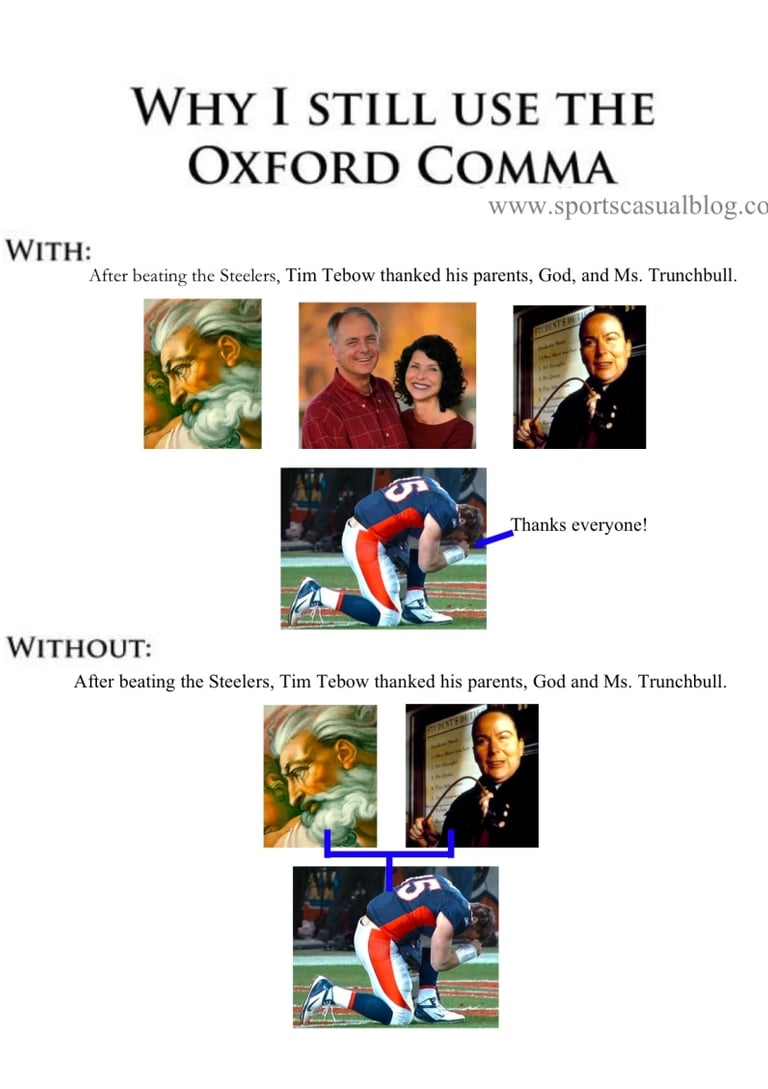
Some love stories are quiet, some are loud, but my love for the Oxford comma is loud, proud, and occasionally misunderstood. That little line that hangs out before the “and” in a list might seem insignificant, but it’s the unsung hero of clarity, style, and, dare I say, justice.
Why do I love it? Let me count the ways (and yes, I will use commas to do it):
1. It prevents chaos.
Without the Oxford comma, sentences can spiral into anarchy. Consider this classic: “I’d like to thank my parents, Beyoncé and God.” Suddenly, my parents are pop royalty — or divine. The Oxford comma swoops in like a superhero: “I’d like to thank my parents, Beyoncé, and God.” Crisis averted. Everyone knows exactly who’s on the gratitude list.
2. It adds a dash of sophistication.
There’s something undeniably elegant about a sentence that respects the Oxford comma. It whispers, “I care about nuance, and I care about clarity.” It’s the linguistic equivalent of wearing a perfectly tailored blazer or finishing your coffee with a flourish of cinnamon.
3. It makes lists safer.
Lists are tricky. Without the Oxford comma, “We invited the strippers, JFK and Stalin” becomes an international incident. Add that little comma, and suddenly it’s just an oddly ambitious guest list: “We invited the strippers, JFK, and Stalin.” Peace is restored, both grammatically and geopolitically.
4. It’s secretly a rule-breaker.
Oxford commas are rebels with a cause. Some style guides say, “skip it.” But I say, “why settle for chaos when you can have clarity with flair?” Using it feels like a tiny act of defiance against ambiguity — and who doesn’t love a little rebellion in prose?
5. It’s consistent, reliable, and comforting.
In a world of uncertainty, fake news, and mysterious kitchen smells, the Oxford comma is a safe harbour. It doesn’t waver. It doesn’t confuse. It simply says, “I’ve got your back, and your lists, and your sanity.”
So yes, I love the Oxford comma. I love it with a passion that can only be rivaled by people who alphabetize their spice racks. It’s tiny, it’s mighty, and it makes my sentences feel like polished gems instead of jumbled necklaces.
And if you, dear reader, still side-eye that little punctuation mark — just know this: somewhere, a sentence is crying for clarity. And the Oxford comma is ready to save it.
